

 By Deep Earth
President William Ruto says Uganda will jointly own shares in the Kenya Pipeline Company (KPC) once its ongoing privatization process is complete.
The announcement was made during the groundbreaking ceremony for the Devki Group’s new steel plant in Tororo, Eastern Uganda, on November 23, 2025, where both President Ruto and President Yoweri Museveni pledged to fast-track infrastructure projects that will ease the movement of fuel, goods and services across the region.
“The ministers were in Nairobi last week and I have given them appropriate guidance on the need for Uganda and Kenya – public and private – to jointly own the KPC; the company that provides the pipeline for supply of fuel into our region,” Ruto said.
He added: “I am happy that Uganda is prepared to co-invest with us because that Kenya pipeline facility is not just a Kenyan facility.”
Kenya will divest 65% of its shares in KPC through an Initial Public Offering (IPO) expected to be finalized by March 31, 2026, while retaining a 35% stake. Parliamentary approval for the process was secured in October 2025.
Uganda is expected to be one of the major co-investors.
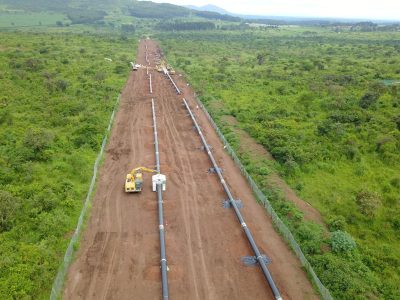
The Kenyan leader also confirmed that plans to jointly extend the refined petroleum products pipeline from Eldoret to Kampala, and further to the borders of Rwanda and the Democratic Republic of Congo (DRC) are at an advanced stage.
Kenya has formally approved a joint co-investment model with Uganda to deliver the project.
“The government of Kenya has given approval for our two governments to work together to co-invest in extending that pipeline so that it can serve East Africa as we jointly own that facility,” said Ruto.

Presidents Ruto (L) and Museveni in Tororo recently
President Museveni welcomed the move, describing it as long overdue for regional efficiency and safety.
“The road transport system is now irrational for trucks moving petroleum products together with cargo and passenger cars. We need to separate this traffic – get the fuel into a pipeline, cargo onto the railway, and leave the roads for light cargo and passenger vehicles,” he said.
What is more, the pipeline extension is expected to eliminate fuel theft and reduce the strain on Uganda’s highways.
Ruth Nankabirwa, Uganda’s Energy and Mineral Development minister also hailed the partnership, noting that it aligns with regional goals of commercial diplomacy and economic integration.
She noted that her team and that of James Opiyo Wandayi, Kenya’s Cabinet Secretary of Energy and Petroleum, were working closely to deliver the Presidents’ vision.

Nankabirwa (C) commemorates the start of direct importation of refined petroleum products by UNOC
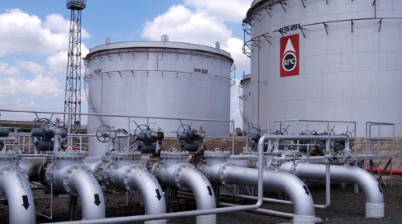
The Uganda National Oil Company (UNOC), which imports all petroleum products for the country, welcomed the development as well. UNOC currently uses the KPC system to transport fuel from Mombasa to Western Kenya before trucking it into Uganda.
“Of course it helps. We are the major transporters within the pipeline. Therefore, it is in our interest to have control in it,” UNOC CEO Proscovia Nabbanja said, when asked about the impact of the joint ownership on Uganda’s fuel security and operations.
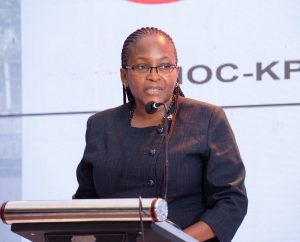
Nabbanja speaking at a KPC event in Kampala in June, 2025
Relatedly, President Ruto announced that Kenya will, in January 2026, officially launch the construction of the Standard Gauge Railway (SGR) extension from Naivasha to Malaba (Uganda border), linking it with Uganda’s planned SGR development towards Kampala and Kasese (DRC border), Rwanda, and South Sudan.
Additionally, he said he would soon commission works to expand the Rironi-Malaba highway into a dual-carriage road – which he fulfilled on November 28, 2025.
The major freight corridor has become increasingly congested, he said.
“Uganda is the largest destination of goods and services from Kenya. Last year, we exported goods worth about KSh 120 billion to this great country,” Ruto said, adding that the infrastructure collaborations would ensure the region shares prosperity not poverty.
Museveni noted that the developments signal a “very bright future” for East Africa; as they would unlock the region’s full economic potential.
What is your reaction?