



The Petroleum Authority of Uganda says the fact that 30% of the contracts that have been awarded in the oil and gas sector have gone to local companies is reason enough for the country to celebrate.
Compared to older oil industries such as Nigeria’s, where it took years for local companies there to match such figures, Uganda has performed better.
“30% national content for a country that has not produced any oil yet is something that many countries never achieved even decades after production. Nigeria, for instance, only started talking about national content 30 years after starting production – and their participation was around 10–15%,” Ernest Rubondo, the executive director of the Petroleum Authority of Uganda (PAU), said.
In monetary terms, Ugandan companies have won contracts worth $2.2 billion out of $7 billion since the international oil companies committed to fund Uganda’s oil project in February 2022.
The local companies have found favour in government policy too, which ringfenced at least 16 services that were strictly reserved for locals.
However, as some applaud the 30%, other industry observers feel the figure is not an accurate reflection of what is on the ground.
While PAU has been vigilant in ensuring that Ugandans are given first priority during the awarding of contracts, shrewd business persons have managed to beat the system to their unfair advantage.
For example, there have been complaints that while some local companies have been issued framework contracts to undertake works, they have not received any instructions from the oil companies to undertake them.
A framework agreement outlines the general terms and conditions for future purchases, such as prices, quality standards, and responsibilities but does not guarantee a specific volume of business to the supplier.
As such, in these circumstances, a closely-knit circle of companies (and not necessarily the local firms holding the framework pacts) have enjoyed a sizeable share of the contracts.
In other incidences, foreigners have hidden behind the cover of local companies to win contracts. While, on paper, the company directors and shareholders are local, the actual beneficial owners are a shadowy team of foreigners – a culture that has been hard for even the regulators to crack down.
Nevertheless, a number of local companies in Uganda’s oil industry have made a fortune.

Rubondo, PAU Executive Director
Delayed Payments
Earlier challenges of delayed payments, especially when McDermott faced financial troubles, appear to have been largely cooled.
McDermott is part of a consortium (together with Sinopec) that was awarded a conditional $2 billion engineering, procurement, construction, and commissioning (EPCC) contract by TotalEnergies for the Tilenga project in 2021.
While McDermott controlled 65% of this contract, internal financial challenges at group level had seen the company struggle to meet some of its contractual obligations, as we reported in our November 2024 Wrapper. The issue even led to a reduction in McDermott’s scope of works.
In 2023, at least 92 Ugandan companies supplying goods and services to the sector demanded $32 million in delayed payments – an amount that nearly saw them lay down their tools; prompting PAU to step in.
In our November 2023 Wrapper we reported that PAU had written to TotalEnergies, the biggest shareholder in Uganda’s oil project, to find a swift resolution to the unpaid arrears of subcontractors.
PAU tasked the French oil major’s Tier I contractors – McDermott and Sinopec – to address the issues that had been ongoing for nearly a year then.
According to Rubondo, PAU’s intervention has since reduced the unpaid amount to about $10 million, with the number of aggrieved companies also dropping, to stand at 62 today.
“It is true a payment challenge exists, but it is a small part of what has been paid out so far. That said, however small a payment is, it needs to be made,” Rubondo said, adding that even Ugandan subcontractors also owed fellow Ugandan suppliers.
While acknowledging the frustration caused by the delayed payments, Rubondo appealed for patience as PAU completes audits and pushes for amicable resolutions.
The service providers in the meantime retain the right to pursue legal action if dissatisfied with the pace of progress, he admitted.
Emmanuel Mugarura, the CEO of the Association of Uganda Oil and Gas Service Providers (AUGOS), fears some affected companies may never recover their money despite PAU’s intervention.
“Some of these Ugandan service providers are losing assets to banks because they have defaulted on their loans. This money was borrowed to honor oil industry contracts. Surely PAU or other state organs can do more and expedite the payment processes,” he said, arguing further that lengthy court procedures were not an option for already distressed suppliers.
National Content Growth
Overall, local participation in the sector (or national content) has seen nearly 20,000 Ugandans employed directly and another 180,000 employed indirectly. Ugandans occupy 64% of management positions, 85% of technical roles, and 99% of support roles, while over 14,000 have received vocational and technical training, and more than 40 joint ventures have facilitated technology transfer worth $300m.
Remarkably, an updated resource assessments now show that the country’s recoverable resources have increased from 1.4 billion to 1.65 billion barrels of oil.
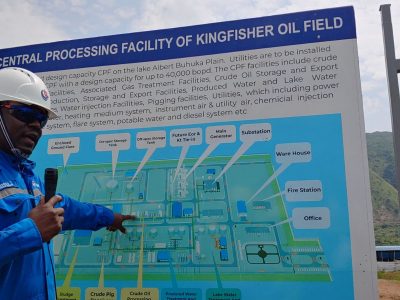
The Tilenga (60%), Kingfisher (74%), and EACOP (75%) projects are now at advanced stages of completion, positioning Uganda on course to achieve First Oil in the second half of 2026.

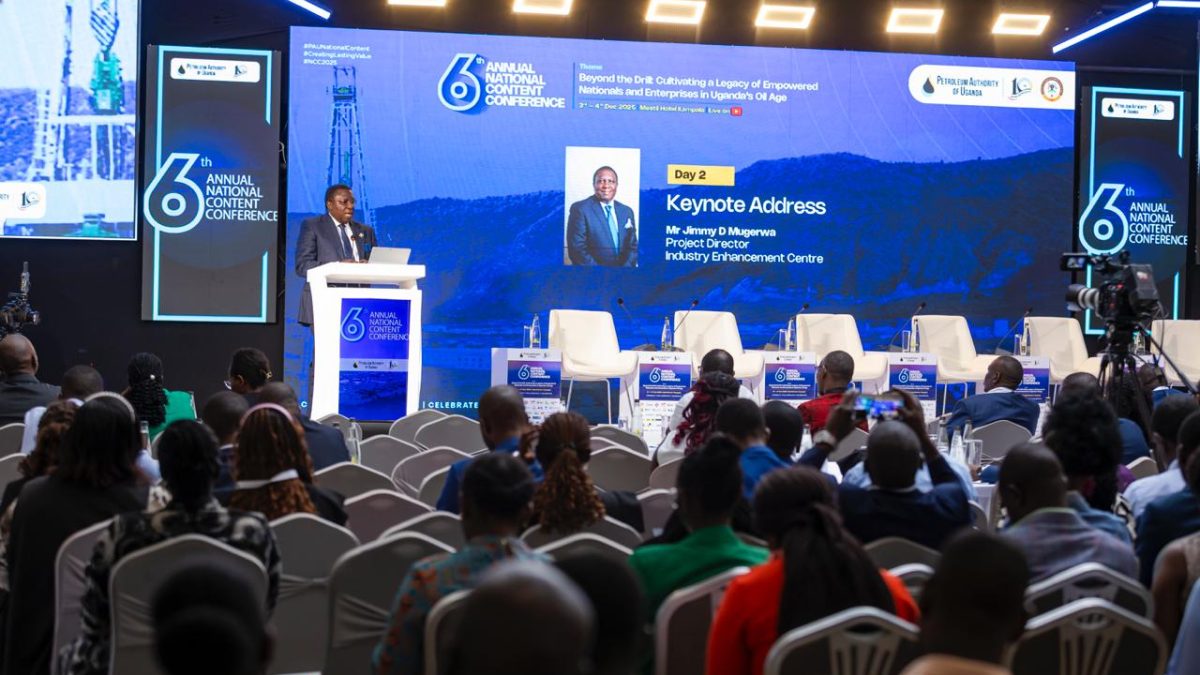
Rubondo (L) leads delegates at PAU’s 6th Annual National Content Conference
Meanwhile, PAU’s 6th Annual National Content Conference enters its second and final day today at Mestil Hotel, Kampala, with discussions centering on upcoming production-phase opportunities as underlined in the theme: “Beyond the Drill: Cultivating a Legacy of Empowered Nationals and Enterprises in Uganda’s Oil Age.”
Both Okasai Opolot, the Minister of State for Energy and Michael Atingi-Ego, Governor of the Bank of Uganda, urged participants to ensure that Uganda’s oil wealth is converted into lasting productive assets.
PAU is marking 10 years of regulating Uganda’s oil and gas sector, this year.
What is your reaction?