



 By Deep Earth
By most accounts, 2026 will be a defining year for Uganda’s energy outlook.
After two decades of anticipation following the discovery of commercially viable oil, Uganda is now firmly on course to produce its first barrel of crude oil in the third quarter of 2026.
Both government and international oil companies are aligned on a July 2026 First Oil schedule – a milestone that is expected to significantly reshape the country’s economic and investment landscape.
Our 2026 Energy Outlook examines how Uganda’s oil, mining, and electricity sectors are likely to perform in what will be both a politically and economically consequential year.
With crude oil production approaching, the country’s capacity to meet its debt obligations is expected to strengthen, potentially unlocking further investment across the broader energy value chain.
While we believe the most direct benefits from oil revenues to mining and electricity may materialize in the medium to long term – as Uganda services loans secured against future oil earnings – the direction of travel is becoming clearer.
In this outlook, we provide a progress report on critical oil infrastructure, including developments at the Kingfisher Development Area, the Tilenga Project, and the East African Crude Oil Pipeline (EACOP).
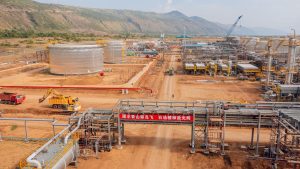
Development works at CNOOC’s Kingfisher oilfields last year
Based on activity levels in the oil fields and construction corridors, we assess the 2026 First Oil timeline as credible and achievable. We, however, predict that the much larger Tilenga field will not be ready this year.
We also look ahead to Uganda’s third oil licensing round, which is expected to see a request for proposals issued for a number of oil blocks in 2026 – a move that could reinvigorate upstream interest even as production nears.
Meanwhile, the mining sector is poised for renewed activity.
Of particular note is the anticipated resumption of operations at Kilembe copper mines in the second quarter of 2026.
Government’s chosen partner, the Sarrai Group, is expected to sign a Joint Operations Agreement (JOA) with the Uganda National Mining Company (UNMC) in January 2026 – clearing the final hurdle before operations restart.
The artisanal and small-scale miners (ASMs) are also expected to ramp up operations as their formalization continues under the ongoing full implementation of the Mining and Minerals Act 2022.
In the electricity sector, attention will be firmly fixed on the state of the country’s distribution network.
By the end of March 2026, the Uganda Electricity Distribution Company Limited (UEDCL) will mark one year as the holder of the national distribution concession.
Persistent outages, public dissatisfaction, and an aging network have already triggered reviews that could shape government decisions in the second half of the year.
We expect UEDCL to focus heavily on financing, loss reduction, and network rehabilitation, as regulatory enforcement tightens.
Beyond infrastructure, this outlook also assesses energy transition dynamics, including government’s expected push for battery energy and storage systems, as well as leadership changes – notably at the Petroleum Authority of Uganda (PAU), where a new executive director is due to take office.
Finally, being an election year, we examine political and business risks, and how the January 15 general elections could influence investment decisions, regulatory approvals, and sector leadership well into mid-2026.
Download the PDF of our 2026 Energy Outlook for Uganda’s Oil, Mining, and Electricity sectors here.
What is your reaction?

