


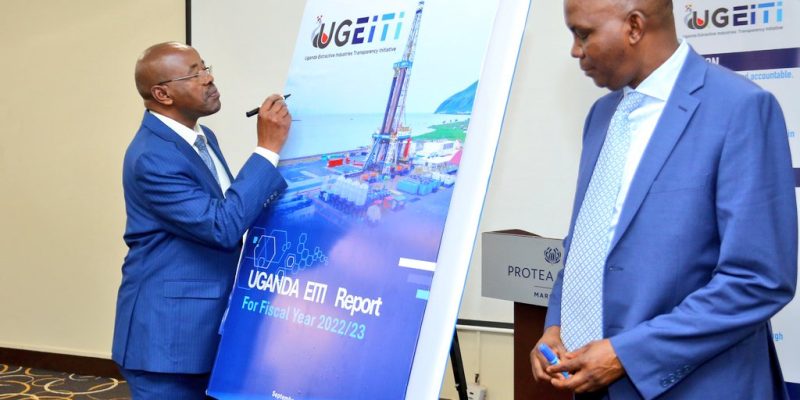
When Uganda joined the Extractive Industries Transparency Initiative (EITI) in August 2020, it chose to expose its most politically sensitive and economically consequential sectors to public scrutiny.
Today the country has produced four EITI reports, with the latest covering the 2022/23 fiscal year.
And just like the previous ones, progress in disclosure has run alongside recurring structural weaknesses, particularly around contract transparency, beneficial ownership, and data quality – issues that now directly affect Uganda’s validation standing under the EITI Standard.
Released in November last year, the fourth report shows total extractive sector revenues of UGX 530.17 billion, a 29% increase from the previous cycle. Mining contributed UGX 299.95 billion, while oil and gas – which is still in pre-production – accounted for UGX 230.23 billion.
But the reconciliation process revealed deeper problems.
Nearly 50% of initially reported revenues required adjustment, with the unreconciled figure initially standing at UGX 750 billion. Late submissions, incomplete templates, uncertified declarations, and missing audited financial statements were common across both companies and government agencies.
“When data comes late, the EITI Secretariat does not have the opportunity to cross-check and reconcile the information shared with it,” said Gloria Mugambe, Head UGEITI.
Based on the reconciliation scope agreed to, six oil and gas companies which held active licenses during the 2022/23 fiscal year as well as fourteen mining companies that made payments over the materiality threshold of UGX 750 million were included.
The oil and gas entities being the Uganda National Oil Company (UNOC), TotalEnergies, CNOOC, Oranto Petroleum, Armour Energy and DGR Energy Turaco.
The mining entities were Tororo Cement, Hima Cement, National Cement Company, Mota Engil, Hua Hui, Metro Cement, Diamond Steel, Wagagai Mining, Sino Minerals, GEMS International, Kampala Cement, Direct Reduced Iron (DRI), Rwenzori Rare Metals and AUC Mining
One of the most persistent challenges identified across all four reports is the absence of a legal framework compelling EITI reporting, with participation voluntary.
The EITI team has particularly struggled to convince the largely secretive mining sector to participate, unlike the petroleum one which is familiar with international disclosure norms.
“Every time mining stakeholders are approached for information, they ask, ‘Is there a law? Am I compelled to do this?’ That challenge keeps coming back,” Mugambe noted.
As such the recommendation to legislate mandatory EITI reporting has appeared repeatedly across reporting cycles.
Uganda’s first EITI validation in May 2024 yielded a moderate score of 78.5%, falling short of the 90% target now being pursued ahead of the next validation in June 2026.
Two issues were decisive: contract transparency and beneficial ownership disclosure.
Production Sharing Agreements (PSAs) in the petroleum sector remain largely undisclosed, despite EITI requirements.
Joshua Lukaye, Assistant Commissioner Upstream – who represented the Energy Minister at the report launch – signaled movement on this front: “The Solicitor General has cleared the disclosure of all oil contracts. What is ongoing now is agreeing on the modalities – how and where they will be published.”
This remains to be seen, however, since similar promises made in the past by even more senior state officials remain unfulfilled.
Meanwhile, incomplete filings by companies at the Uganda Registration Services Bureau (URSB), coupled with weak enforcement, means that disclosure of true company owners remains one of the country’s weakest compliance areas.
“Whenever we fail to disclose this information, we are marked down,” said Mugambe.
Another striking governance challenge that keeps showing up relates to discrepancies between mineral production and export figures, particularly for gold. These gaps stem largely from Uganda’s extensive informal artisanal and small-scale mining (ASM) sector.
“DGSM only captures production from licensed operations yet the Uganda Revenue Authority (URA) captures whatever is exported – whether the production was licensed or not,” David Sebagala, a Senior Inspector of Mines at the Directorate of Geological Survey and Mines (DGSM), explained.
With an estimated 80% of ASM operations unlicensed, DGSM cannot legally report much of the gold being produced, even as it leaves the country through formal export channels.
“I can’t be fighting illegal mining while another agency allows that product to access the market. We need to work as one bloc,” noted Sebagala.
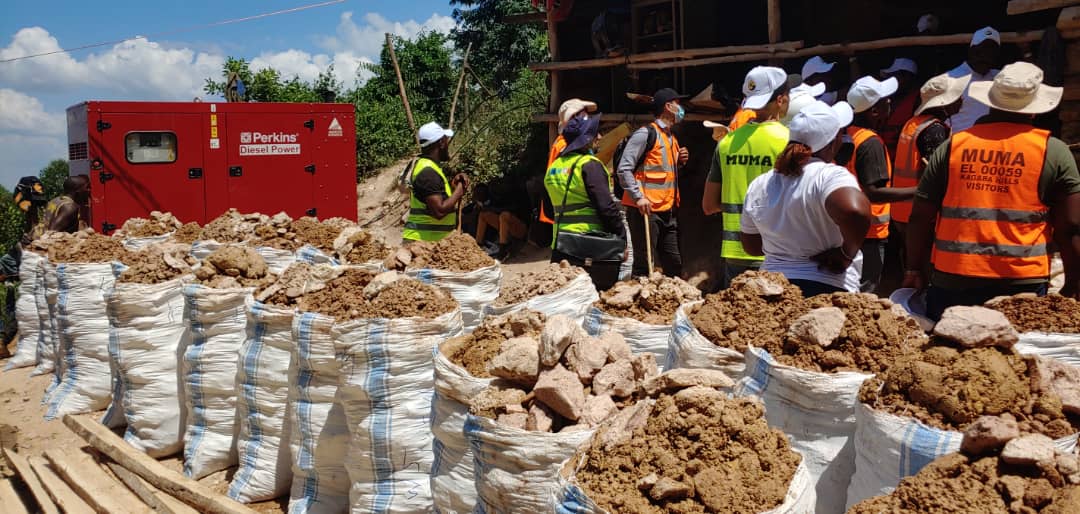
An artisanal miner at a Mubende United Miners’ Assembly (MUMA) pit in Kassanda. MUMA was licensed last year
Lawrence Muwonge, URA’s Manager for Extractives, said the gaps were known and the tax body was planning reforms.
“We’re developing an enhanced online fiscal regime platform that will track taxpayers from registration to production and payment – by license area,” he said.
URA is also extending the Electronic Fiscal Receipting and Invoicing System (EFRIS) to mining and quarrying, aiming to monitor production, sales, and stock more accurately –particularly among ASMs.
Relatedly, Mugambe wants to see local government royalties meaningfully analyzed since communities hosting extractive activities still struggle to trace how much revenue flows back to their districts and how it is spent.
Still Matters
For government, EITI is not merely a reporting obligation but a fiscal and development tool.
State Minister for Finance and Planning, Amos Lugoloobi emphasizes its domestic value: “This report does more than fulfil an international obligation. It strengthens our domestic system of accountability and transparency.”
He linked EITI directly to domestic revenue mobilization, noting that as donor funds decline, Uganda must rely more on extractive revenues – making leakages and illicit flows increasingly costly.
The EITI’s implementation in Uganda is overseen by a 26-member Multi-Stakeholder Group (MSG), bringing together government, industry, and civil society organizations (CSOs) like the Natural Resource Governance Institute (NRGI), the Advocates Coalition for Development and Environment (ACODE), Southern and Eastern Africa Trade Information and Negotiations Institute (SEATINI) and Global Rights Alert (GRA).
The MSG approves annual work plans of the EITI secretariat, oversees reporting, and ensures that disclosures reflect the full extractive value chain.
According to Moses Kaggwa, Director of Economic Affairs at the Ministry of Finance and the Chairperson of the MSG, the value of this arrangement goes beyond reporting.
“Transparency breeds confidence – the entire public will rally behind the government, confident that it’s doing the right thing. Accountability helps everybody know exactly how much money was received and what it has been put to.”