


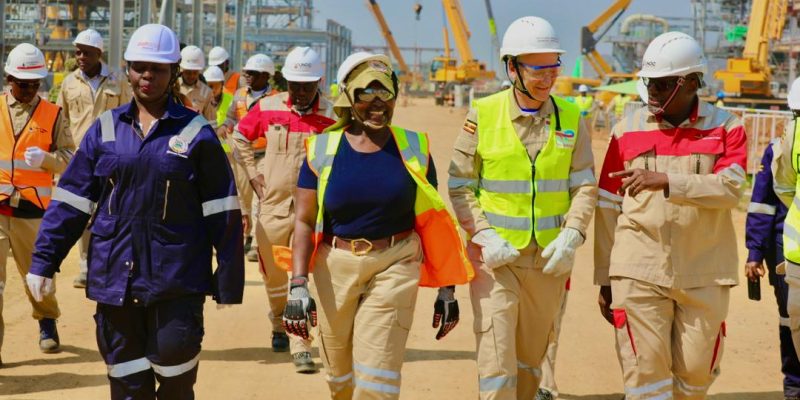
Ruth Nankabirwa, Uganda’s Minister for Energy and Mineral Development, radiates exuberance and high energy – qualities that feel particularly necessary as the country enters the final stretch towards producing its first barrel of oil – 20 years after commercial discoveries were made.
Getting to this point, however, has been anything but smooth.
Uganda’s oil and gas journey has been marked by complex tax disputes, intense scrutiny from environmental activists concerned about biodiversity, and major land acquisition challenges.
Additional bottlenecks have included difficulties in securing financing for infrastructure such as the East African Crude Oil Pipeline (EACOP), shortages of skilled local personnel at critical phases, and governance weaknesses within sections of the local supply chain.
It is perhaps against this backdrop that President Yoweri Museveni appointed Nankabirwa – one of his longest-serving ministers – to the energy docket in June 2021, confident that her vibrancy and persistence would help push Uganda’s oil and gas projects across the finish line.
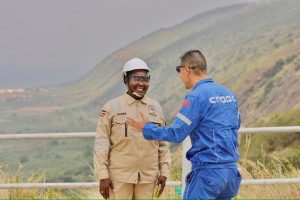
First oil is now firmly targeted for July 31, 2026 – a date the minister ensured executives and staff from CNOOC, TotalEnergies and EACOP Ltd kept top-of-mind during her mid-January tour of project sites in the Albertine Graben.
Over the three-day visit, her favourite questions were direct and repeated: “Will this be ready by July?” quickly followed by “What needs to be done to ensure it is ready?”
The responses were largely reassuring. Funding has been secured. Most equipment is already on the ground, with only a handful of items still in transit. Workforce numbers have been increased where necessary, and extended work shifts introduced.
As Deep Earth International reported in October last year, the July 2026 target now appears within sight, with major infrastructure at CNOOC’s Kingfisher Development Area (KFDA), TotalEnergies’ Tilenga project and the EACOP nearing completion.
At the Kingfisher oil field, operated by China’s CNOOC, overall works are over 90 percent complete, particularly at the Central Processing Facility (CPF) and the well pads.
The Kingfisher CPF, designed to handle up to 40,000 barrels of oil per day, will process crude oil and associated gas, with facilities for crude treatment, gas handling, storage, liquefied petroleum gas (LPG) production and export all nearing completion.
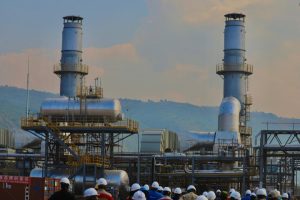
Part of the Kingfisher CPF
17 development wells have already been drilled, in addition to the four exploration wells – that will also be used – meaning the project has surpassed the 19 wells threshold for production to begin. A total of 31 wells will be drilled at Kingfisher.
Meanwhile, 178 wells have been drilled at TotalEnergies’ Tilenga project (170 were required for the field to be ready for first oil). The field has a peak production capacity of 190,000 barrels per day.
The company’s CPF is taking shape with two major processing trains designed to separate oil, gas and water before export. The strategy is to first commission one train to align with first oil demands as the other is completed (staggered commissioning).
The CPF includes oil stabilization units, on-spec and off-spec storage tanks, LPG extraction and storage facilities, nitrogen processing utilities and a gas-fired power generation area. TotalEnergies plans to generate up to 60 megawatts of electricity from associated gas, with surplus power exported to the national grid – a move that also supports carbon emissions reduction.
A particularly critical focus at Tilenga is the Electrical, Instrumentation and Telecommunication (EIT) infrastructure. Three major EIT buildings – North, South and West – will control utilities, water treatment, power generation and oil processing.
Their completion is essential before more than 3,000 kilometres of cable can be pulled and connected across the project.
To stay on track, TotalEnergies has increased its workforce to nearly 7,000 people, up from an initially planned peak of 5,000, and introduced night shifts to ensure round-the-clock progress.
Solving the additional workers’ accommodation needs is a going concern, says Philippe Groueix, the General Manager.
Their productivity on the job and efficiency (including quick meals) is paramount, as well, he noted.
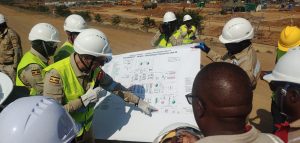
Groueix shares a progress report on Tilenga
Meanwhile maintaining the agility to hire the specific workers – be it welders, civil engineers or electrical and instrumentation experts – is also important since as one specialty is being demobilized another is being mobilized, in real time.
Over 90 percent of concrete works are complete, with steel works expected to be finalized within the first quarter of this year.
Tilenga is also employing horizontal directional drilling (HDD) technology to lay pipelines beneath the Victoria Nile, allowing oil fields north of the river to connect to the CPF without disturbing the riverbed or the sensitive ecosystem of Murchison Falls National Park.
EACOP
The 1,443-kilometre EACOP – stretching from Kabaale, Hoima to the Chongoleani Peninsula near Tanga Port – will transport Uganda’s crude to international markets at a peak capacity of 246,000 barrels per day.
EACOP Ltd, in which TotalEnergies holds 62 percent, the Uganda National Oil Company (UNOC) and Tanzania’s TPDC each control 15 percent, and CNOOC owns 8 percent, reported overall project progress of 79 percent as of mid-January 2026.
Line pipe manufacturing in China was completed in September 2025, insulation works in Tanzania concluded in December, and the final batch of pipes for the Ugandan section arrived on January 10.
Pipeline construction stands at 62 percent, with over 1,400 kilometres welded and 500 kilometres fully buried and backfilled.
Above-ground installations are advancing steadily, particularly at Pump Station 1 (PS1) in the Kabalega Industrial Park (KIP) in Kabaale – described by EACOP Deputy Managing Director John Bosco Habumugisha as “the heart of EACOP.”
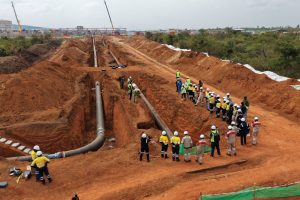
The Tilenga feeder pipeline (R) and the export pipeline (L) at PS1
PS1 will receive crude from both Kingfisher and Tilenga via feeder pipelines, measure and blend the volumes, ensure quality specifications, and pump the oil through to Tanzania.
In the future, it will also supply up to 60,000 barrels of oil per day to Uganda’s planned refinery (whose ESIA is underway).
“EACOP remains on schedule for July 31, 2026,” Habumugisha said, noting that over 90 percent of the project’s workforce is East African, supported by international experts to ensure global standards and technology transfer.
He emphasized that environmental compliance has been rigorously assessed and meets both Ugandan and international benchmarks.
Nankabirwa’s Albertine visit followed a similar tour to Tanzania in the first week of January, where she inspected the Marine Terminal and Tanks (MTT) and jetty facilities at Tanga, as well as HDD works at the Sigi River crossing – critical components for Uganda’s crude export route.
Generally, the two countries were moving in tandem, the minister noted. The EACOP marine loading jetty in Tanga – stretching about two kilometres into the Indian Ocean – is already complete, while the Marine Storage Terminal (MST), with four large crude tanks, is more than 80 percent finished.
“So, come July, I think we shall have harmonised,” she said.
Synchronization
For Nankabirwa, the final hurdle is synchronization.
“All the three major sections – EACOP, Tilenga and Kingfisher – must be ready at the same time. A delay in one component would inevitably slow the entire system,” she stressed.
For instance, storage capacity (on-spec tank) at the Kingfisher CPF can only hold crude for about 30 hours, meaning oil must flow continuously into the export pipeline.
Beyond the physical infrastructure, the minister underscored the importance of institutional alignment.
She revealed plans to formulate a high-level coordination committee drawing representatives from critical government ministries, departments and agencies (MDAs), including the Ministries of Energy, Finance, Water and Environment, ICT, and Works and Transport.
The aim is to ensure that upstream petroleum operations are not slowed down by avoidable administrative or logistical bottlenecks as the country approaches first oil.
“The production of petroleum products requires multifaceted efforts,” Nankabirwa noted, adding that constant coordination across MDAs is now essential.
Her ministry, she said, is already working closely with other arms of government to resolve outstanding issues ranging from power supply and water access to digital connectivity and road infrastructure in the oil-producing regions.
Stable electricity supply to the CPFs remains a critical priority, with substations dedicated to the oil projects in the offing.
The Kabalega International Airport will also be commissioned in late March or early April this year.
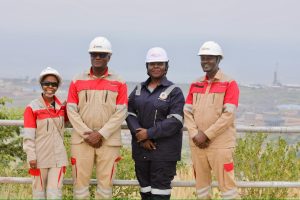
Energy Ministry PS, Irene Bateebe (2nd R) poses with the UNOC team led by chairman Mathias Katamba (2nd L), Zulaika Kasajja (L), a board member and Felix Okot (R), Head Refinery Development
On the commercialization front, UNOC is positioning itself to play a central role once production begins.
As part of this preparation, the company has moved to operationalize its Crude Oil Marketing and Trading Business Unit, recently advertising for a candidate to head the section.
Once commercial production starts, the crude will be sold either through spot market transactions (one-off sales) or through term sales.
This dual-track approach is intended to give Uganda flexibility in managing price volatility while securing stable revenues, particularly in the early years of production.
Pictorial
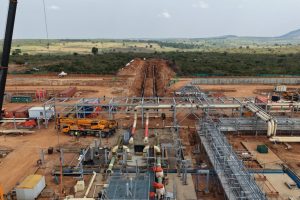
Ongoing works at EACOP’s PS1
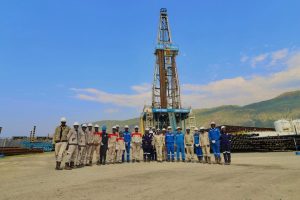
The CNOOC rig at work at Kingfisher
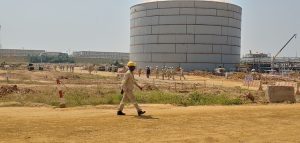
A Tilenga worker catches a break
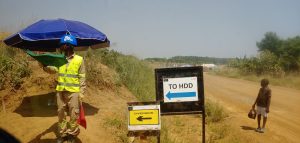
Signage to TotalEnergies’ horizontal directional drilling (HDD) spot

An interaction with Project Affected Persons (PAPs)

A replacement house built by the Tilenga project for one of the PAPs
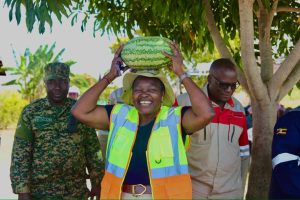
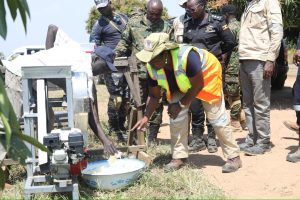
The guests bought various items produced by the PAPs including fruits, honey and cassava flour
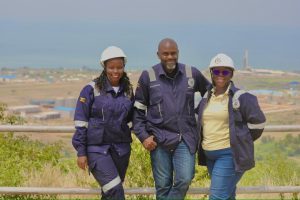
Dr Patricia Litho (R), Asst. Commissioner, Communications at the Energy Ministry together with colleagues: Sarah Nanteza (L) and Ivan Senfuma
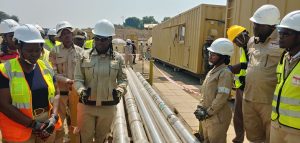
Joan Namukasa (C), Manager Drilling and Completions at PAU interacts with the minister