


With donor budget support no longer guaranteed, Uganda continues to make deliberate moves to improve the performance of its extractive sectors to boost domestic revenue mobilization.
Today, minerals and oil and gas are positioned as key sectors that must translate into broad-based economic activities, driving industrialization and creating jobs through value addition and sectoral linkages to catalyze the rest of the economy.
Government has included the extractives as a key pillar in the economic transformation of the country.
But there remains a major challenge – matching the management of the minerals sector to that of oil and gas.
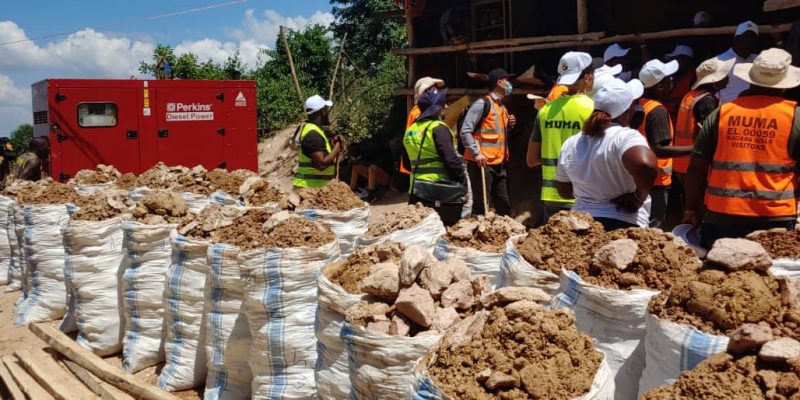
Making the challenge steeper is the fact that the largely informal artisanal and small–scale mining (ASM) subsector contributes over 90% to Uganda’s mineral production, employing over 60% of the workforce (about 1 million in direct and indirect jobs), and adding significant value estimated at over $850 million (UGX 3 billion). ASMs mainly produce gold alongside limestone, tin, and gemstones.
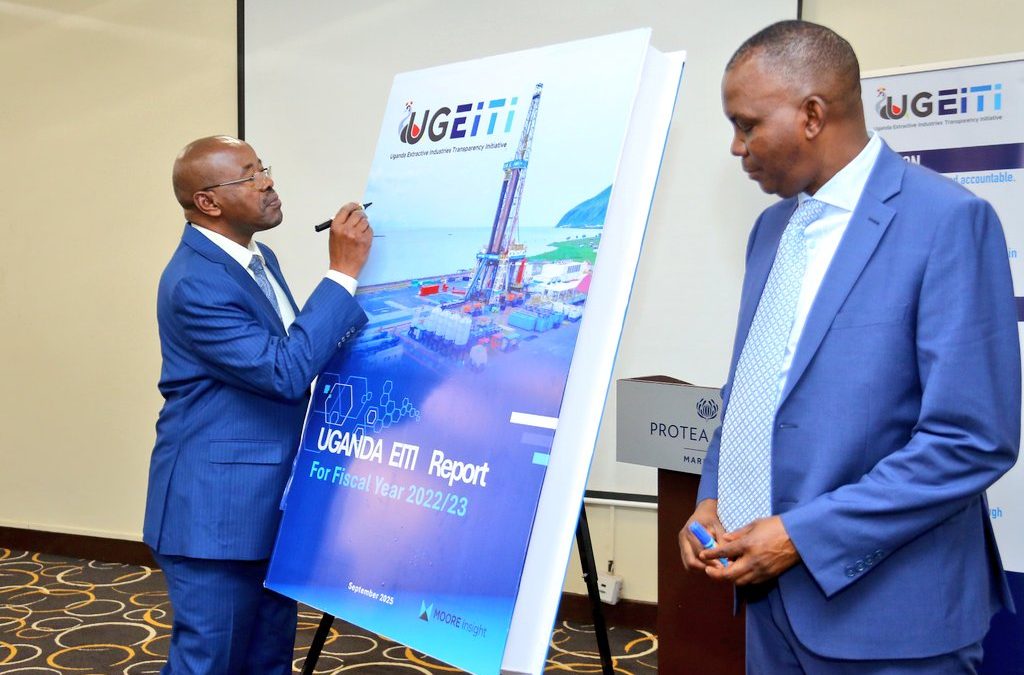
At the launch of Uganda’s fourth Extractive Industries Transparency Initiative (EITI) report in November last year, one of the most heated discussions centered on how to meaningfully include ASMs in the transparency process.
The government’s formalization efforts, spurred by the Mining and Minerals Act, 2022, aim to integrate this vital group in the economy proper, starting with their licensing.
Mid last year regulations were also issued, designating specific mining areas for ASMs, a critical step towards ratification of their activities.
A biometric registration program is also ongoing which has so far registered about 7,000 artisanal miners, including just over 2,000 women in Kassanda, Busia, Namayingo, Buhweju, Rubanda, Ntungamo and Abim.
So far, eight small-scale and one artisanal mining licenses have been issued by the Ministry of Energy and Mineral Development.
The ASMs are, however, not yet part of the EITI process that aims to promote accountability, good governance, and better revenue management in the oil, gas, and mining sectors.
The latest EITI report covers the 2022/23 fiscal year, which was before the recent ASM formalization processes.
“The EITI methodology does not yet capture the informal sector. The point of departure for reporting is the existence of a license. Because most ASMs are unlicensed, they are not captured – even though they contribute a lot,” explains Gloria Mugambe, Head of the Uganda EITI Secretariat.
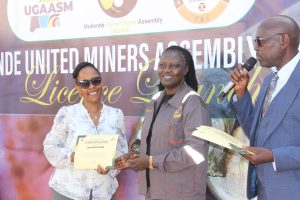
Mugambe (L) receives a certificate from Agnes Alaba, Commissioner for Mines and Bukya (R) in recognition of EITI’s support to MUMA
In the latest report, total extractive sector revenues reached UGX 530.17 billion ($152m), a 29% increase from the previous year. Mining accounted for UGX 299.95 billion ($86m), surpassing oil and gas revenues, which stood at UGX 230.23 billion ($66m) in a pre–production phase.
Six oil and gas companies and fourteen mining companies that paid above a UGX 750 million ($213,845) materiality threshold were included.
Without capturing the ASMs’ significant contribution, however, these numbers remain unrepresentative – creating governance and planning challenges for the state.
After all, EITI is not merely a reporting obligation but a fiscal and development tool that strengthens “our domestic system of accountability and transparency”, according to Amos Lugoloobi, the State Minister for Finance and Planning.
Some artisanal gold sites are said to be producing 1.5 to 2.5 kg per week; with ASMs said to contribute significantly to gold exports, which today dominate Uganda’s exports (even surpassing coffee as a forex earner, now and then).
Now the latest figures from Bank of Uganda (BoU) indicate that the country’s gold exports last year increased by 75.8% from 2024, helped by record prices that attracted new dealers into the sector.
Adam Mugume, the central bank’s executive director for research and economic analysis, told Reuters recently that the growth from $3.3b (UGX 11.6 trillion) to $5.8 billion (UGX 20.5 trillion) would be attributed to the soaring international gold prices; which saw a kilogram averaging $140,000 at the end of 2025.
The Uganda Revenue Authority (URA) is said to have recorded about 59,000 kilograms of gold exports last year (including Wagagai Mining’s 1,100kgs), that brought in about UGX 43 billion ($12.2m) in export levies.
Discrepancies
But perhaps the most visible consequence of ASM exclusion is the persistent discrepancy between gold production and export figures reported by different government institutions.
David Sebagala, a Senior Inspector of Mines at the Directorate of Geological Survey and Mines (DGSM), explains the problem: “DGSM reports only production from licensed operations. But 80% of ASM operations are illegal and unlicensed, so we cannot report their production.”
At the same time, the URA records gold exports that have passed through formal customs channels – whether the production was licensed or not. This creates the perception of unexplained volumes – often attributed, controversially, to smuggling from across the borders.
What is not in doubt is that Uganda has increasingly become a regional hub for refining and subsequently re-exporting gold coming in from neighbouring states – something that the URA acknowledges.
In the meantime though, Sebagala wants state institutions and agencies to always work in tandem. Noting, “I cannot fight illegal mining while another agency allows that product to access the market.”
To its credit, the tax body says reforms are underway.
Lawrence Muwonge, Manager for Extractives at URA, notes that a new integrated fiscal regime platform will track mining and petroleum activities from registration to export – by license area.
URA is also extending the Electronic Fiscal Receipting and Invoicing System (EFRIS) to mining and quarrying, aiming to monitor production, sales, and stock more accurately – particularly among ASMs.
“It will monitor production, sales, stock and exports – and DGSM will be able to see what is leaving the country in real time,” Muwonge explains.
Meanwhile, apart from the biometric registration of ASMs, the Ministry of Energy is also planning mineral markets, weighbridges and recruitment of additional inspectors, according to Joshua Lukaye, an Assistant Commissioner at the Ministry.
“We recognise the challenges and are acting. These measures will address under-declaration and data gaps,” Lukaye says.
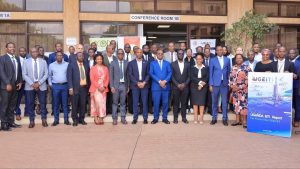
Guests after the launch of the fourth EITI report
Formalization hurdles
While the new legal regime seeks to welcome ASMs to the formal side, licensing comes at a steep cost.
John Bosco Bukya, the Chairperson of the Uganda Association of Artisanal and Small-Scale Miners (UGAASM), estimates that an ASM association can spend between UGX 60 million ($17,108) and UGX 150 million (42,769) before qualifying for a mining license.
“At least $10,000 (UGX 36m) is needed just to carry out an Environmental and Social Impact Assessment (ESIA),” Bukya says.
Beyond ESIA costs, miners must secure landowner agreements, register entities, prepare audited accounts, prove financial capacity, pay application fees, cover land verification costs and annual ground rent – all before mining legally.
This can only mean a delayed association with the EITI process, for many of the ASMs.
Kenneth Asiimwe, the CEO, UGAASM, says a tradeoff can help solve the impasse.
“Compliance to EITI comes at a cost. If I spend 10% on being compliant, it should return 20 or 30% in my business operations. Transparency must make business sense,” says Asiimwe.
Compliance can be linked to tangible incentives, such as prioritization for Parish Development Model (PDM) funding, for one.
“If transparency merely ends with a pat on the back, ASMs will not comply. However, if being transparent unlocks capital or market access, they will rush to submit data,” he adds.
Both Asiimwe and Bukya suggest more pragmatic approaches to formalization. For instance adopting the much cheaper Environmental Management Plans (EMPs) instead of ESIAs would be a reasonable alternative for ASMs – something Tanzania is already doing.
Crucially Asiimwe believes that without the equivalent of a Petroleum Authority of Uganda (PAU) to monitor, regulate, and promote efficient, sustainable and transparent mining activities, the sector will continue to struggle.
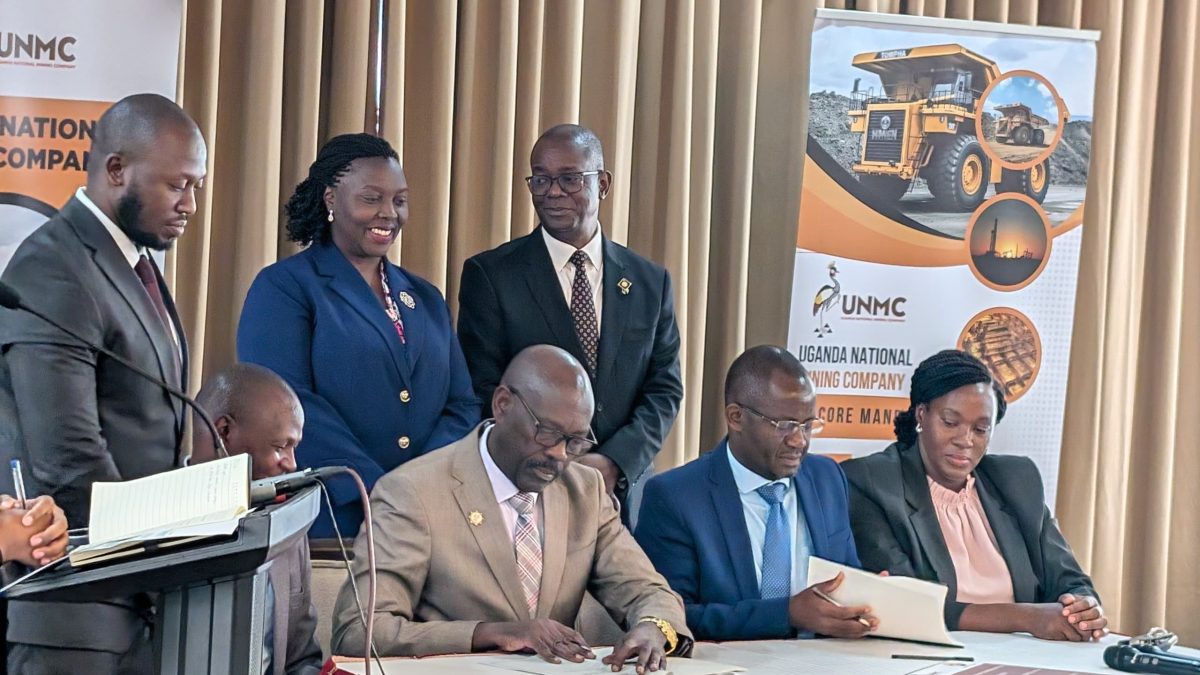
For now partnerships with the likes of the Uganda National Mining Company (UNMC) should help the ASMs’ formalization case.
Uganda-centric
According to Winfred Ngabirwe, the Executive Director, Global Rights Alert (GRA), adopting a Uganda-centric approach – away from the internationally-structured EITI standard – will make it easier for ASMs to be captured in the process.
“For long, EITI discussions had been confined to boardrooms and formal platforms without the voices of the host communities and miners – the people most affected. EITI needs to adopt a local bottom-up approach to include the informal but vital groups,” she says.
Without a national EITI template that reflects realities in mining destinations like Busia, Kassanda and Karamoja, Ngabirwe warns that ASM production will continue to be invisible.
“If we only champion the international standard, we miss our local context. We should have an approach that is relevant, applicable, accessible and meaningful,” she notes.
In the past, civil society has played a critical role in closing this gap; leading field visits to Kassanda that exposed MSG members to on-the-ground realities, ultimately leading to ASM representation on the MSG.
“Today, miners are in the room informing policy,” Ngabirwe says, calling it a transformative shift for Uganda’s EITI process.
For Dr. Arthur Bainomugisha, the Executive Director, at the Advocates Coalition for Development and Environment (ACODE), the stakes are clear.
“Mining is our next big thing. In the long run, we are likely to earn more from minerals than from oil and gas. Make licensing easy and capture as many miners as possible. Otherwise, our statistics and our policy decisions will always be wrong” he says.
Formalising ASMs is not optional but essential – not just for EITI compliance, but for Uganda’s broader growth ambitions, Bainomugisha concludes.
The EITI’s implementation in Uganda is overseen by a 26-member Multi-Stakeholder Group (MSG), bringing together government, industry, and civil society organizations (CSOs) like ACODE, GRA, the Natural Resource Governance Institute (NRGI) and the Southern and Eastern Africa Trade Information and Negotiations Institute (SEATINI).